
Professional vacuum packers
Professional chamber and external-suction vacuum packers, with sealing bars from 260 to 570 mm depending on the model. Shipping to the United Kingdom is quoted individually: the cost and delivery time depend on the equipment and the delivery address. Contact us for a personalised quote. Chamber vacuum packers make up most of the catalogue; external-suction models work with embossed bags.
Showing 1–24 of 40 resultsSorted by price: low to high
-

Clima Hostelería MVS-3150S 350 mm external-suction vacuum packer
208,60 € + VAT · 252,41 € inc. VAT Add to basket -
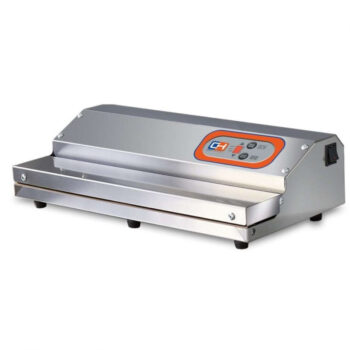
Clima Hostelería FAST35 350 mm external-suction vacuum packer
334,93 € + VAT · 405,27 € inc. VAT Add to basket -
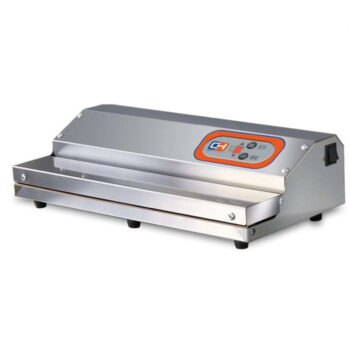
Clima Hostelería FAST40 400 mm external-suction vacuum packer
372,01 € + VAT · 450,13 € inc. VAT Add to basket -
Sale!
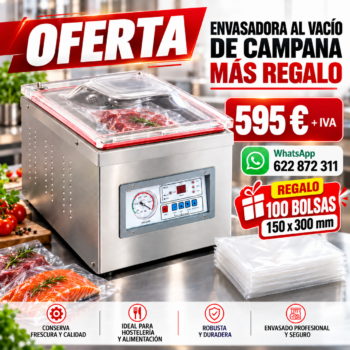
Clima Hostelería DZ-260T vacuum packer with 260 mm bar
Original price was: 605,15 €.595,00 €Current price is: 595,00 €. + VAT · 719,95 € inc. VAT Add to basket -

Corequip SV A external-suction vacuum packer with 470 mm bar
661,60 € + VAT · 800,54 € inc. VAT Add to basket -
Irimar EVT-260 chamber vacuum packer with 260 mm bar
839,80 € + VAT · 1.016,16 € inc. VAT Add to basket -
Irimar EVT-300 chamber vacuum packer with 300 mm bar
965,80 € + VAT · 1.168,62 € inc. VAT Add to basket -
Irimar EVT-400 chamber vacuum packer with 400 mm bar
968,80 € + VAT · 1.172,25 € inc. VAT Add to basket -
Clima Hostelería DZ-400T vacuum packer with two 400 mm bars
970,00 € + VAT · 1.173,70 € inc. VAT Add to basket -
Clima Hostelería DZ-400F vacuum packer with cabinet and two 400 mm bars
1.000,00 € + VAT · 1.210,00 € inc. VAT Add to basket -
Irimar EVT-350 chamber vacuum packer with 350 mm bar
1.141,60 € + VAT · 1.381,34 € inc. VAT Add to basket -
Corequip SV1 4 external-suction vacuum packer with 4 m³/h pump
1.210,00 € + VAT · 1.464,10 € inc. VAT Add to basket -
Irimar EVT-450 chamber vacuum packer with 440 mm bar
1.256,20 € + VAT · 1.520,00 € inc. VAT Add to basket -
Clima Hostelería CHE350 vacuum packer with seamless deep-drawn chamber
1.259,00 € + VAT · 1.523,39 € inc. VAT Add to basket -
Irimar EVT-420+420 chamber vacuum packer with two 420 mm bars
1.270,00 € + VAT · 1.536,70 € inc. VAT Add to basket -
Clima Hostelería DZ-500F vacuum packer with square 520 × 520 mm chamber
1.287,00 € + VAT · 1.557,27 € inc. VAT Add to basket -
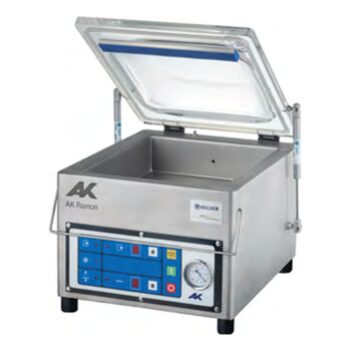
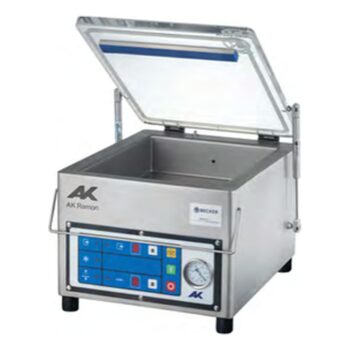
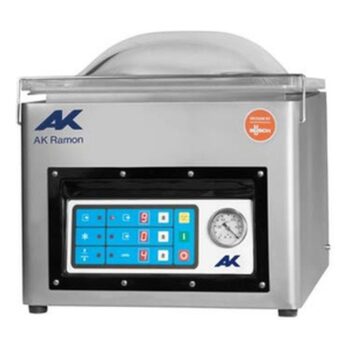
AK Ramon VP-280 chamber vacuum packer with 280 mm chamber
Price range: 1.386,00 € through 1.537,00 € + VAT · 1.677,06 € – 1.859,77 € inc. VAT Select options This product has multiple variants. The options may be chosen on the product page -
Clima Hostelería CHE400 chamber and external-suction vacuum packer
1.446,00 € + VAT · 1.749,66 € inc. VAT Add to basket -
Clima Hostelería CHE450 vacuum packer with 450 mm bar
1.647,00 € + VAT · 1.992,87 € inc. VAT Add to basket -
Clima Hostelería CHE450DUAL vacuum packer with two 450 mm bars
1.741,00 € + VAT · 2.106,61 € inc. VAT Add to basket -
Corequip ST Professional chamber vacuum packer with 9 programmes
Price range: 1.869,40 € through 2.732,80 € + VAT · 2.261,97 € – 3.306,69 € inc. VAT Select options This product has multiple variants. The options may be chosen on the product page -
AK Ramon VP-370 chamber vacuum packer with 370 mm chamber
Price range: 1.874,00 € through 1.947,00 € + VAT · 2.267,54 € – 2.355,87 € inc. VAT Select options This product has multiple variants. The options may be chosen on the product page -

Irimar EVT-500+500 floor-standing vacuum packer with two 500 mm bars
1.888,00 € + VAT · 2.284,48 € inc. VAT Add to basket -
AK Ramon VP-430 chamber vacuum packer with 430 mm chamber
Price range: 2.138,00 € through 2.367,00 € + VAT · 2.586,98 € – 2.864,07 € inc. VAT Select options This product has multiple variants. The options may be chosen on the product page





Guides to choosing and using professional vacuum packers
Practical advice related to this equipment.
The 7 most common mistakes when vacuum packing food in catering
The seven most common mistakes when vacuum packing in a professional kitchen and how to avoid them: bags too…
Read the tip
Which vacuum packer is best for your business?
Which type of vacuum packer suits your workload and product: external-suction, compact chamber or professional chamber.
Read the tipProfessional vacuum packers
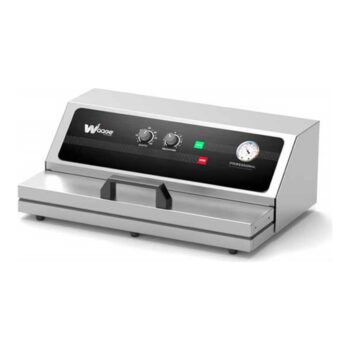
The professional vacuum packer extracts the air from the bag and seals it with a sealing bar. The product pages in this section are grouped into two systems, chamber and external suction, and several formats: countertop, cabinet or floor-standing, plinth and industrial. The vacuum bags and the accessories are in their own sections within professional vacuum packing.
Chamber vacuum packers
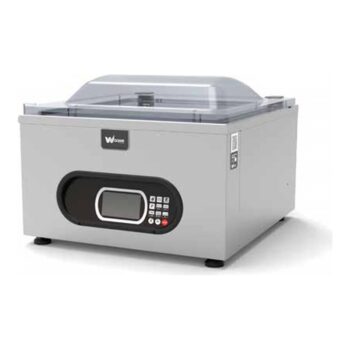
In the chamber vacuum packer the whole bag goes into the chamber, the lid closes and the vacuum is created throughout the enclosure. The professional chamber vacuum packer takes smooth and embossed bags and, according to its product pages, can pack products with liquid.
- Countertop chamber vacuum packers number 24 product pages, with bars from 260 to 570 mm, one or two bars depending on the model, and pumps from 8 to 25 m³/h; the 960 mm model in the FAST version has two 20 m³/h pumps.
- Some countertop models have a 7-inch touch screen with 100 programmes, others a seamless deep-drawn chamber, and three of them combine chamber vacuum with external suction for embossed bags, such as the 400 mm chamber and external-suction vacuum packer.
External-suction or chamberless vacuum packers
The external-suction vacuum packer, also called a chamberless vacuum packer, has no chamber: only the mouth of the bag is placed on the bar and the machine extracts the air from outside, so the bag length is not limited by a chamber. It works with embossed bags.
- There are 7 product pages, with bars from 350 to 470 mm and pumps from 20 to 35 l/min; the 470 mm external-suction vacuum packer has a 4 m³/h pump.
- The product pages show a 220 or 230 V power supply depending on the model.
Countertop, floor-standing and plinth models
- Cabinet or floor-standing vacuum packers number 3 product pages, with two 400 or 500 mm bars and a 20 m³/h pump, including the vacuum packer with square 520 x 520 mm chamber.
- Plinth vacuum packers number 6 product pages, with 580, 800 and 1,000 mm wide chambers, pumps from 20 to 100 m³/h, double sealing and wheels; the VPT versions have a touch screen.
- Industrial vacuum packers number 2 product pages: the VP-700 TB, with an 836 x 680 x 200 mm chamber and a 100 m³/h Busch pump, and the VP-900 TBA, with a 1,005 x 830 x 200 mm chamber, a 302 m³/h Busch pump and semi-automatic lid opening.
Sealing bar, pump and chamber
- The sealing bar sets the maximum bag width: a 400 mm bar seals bags up to 400 mm wide. With two bars, two bags are sealed in the same cycle.
- The pump is expressed in m³/h or l/min, depending on the manufacturer, and each product page shows the figure for its model.
- The chamber sets the size and height of the product that fits; in this section it ranges from 280 x 355 mm to 1,005 x 830 mm of surface area.
Power supply depending on the model
External-suction vacuum packers, countertop chamber models and 580 mm plinth models run on 220 or 230 V single-phase on the models whose product page says so. The 800 and 1,000 mm plinth vacuum packers and the two industrial models need 400 V three-phase.
How to choose a professional vacuum packer
- The system: chamber, with smooth or embossed bags and products with liquid, or external suction, with embossed bags.
- The bar width compared with the width of the bag to be used.
- The size and height of the chamber compared with the product.
- One or two bars, depending on the number of bags per cycle.
- The pump flow rate and the daily packing volume.
- The power supply available: single-phase or three-phase.
- The format: countertop, cabinet or floor-standing, plinth or industrial.
To close trays with film there are the tray sealers.
Frequently asked questions about professional vacuum packers
What is the difference between a chamber vacuum packer and an external-suction one?
The chamber vacuum packer creates the vacuum with the bag inside a closed chamber. The external-suction vacuum packer has no chamber: it draws the air out through the mouth of the bag, which stays outside the machine.
Which bags does a chamber vacuum packer use?
Smooth bags and also embossed bags. Cooking bags up to 120 ºC are used only in chamber vacuum packers. They are all in professional vacuum bags.
Which bags does an external-suction vacuum packer use?
Embossed bags, whose texture lets the air out. Smooth bags do not work in this type of vacuum packer.
One or two sealing bars?
The single-bar vacuum packer seals one bag per cycle. The two-bar model seals two bags in the same cycle, one on each bar.
What does the pump flow rate mean?
The flow rate is the volume of air the pump extracts per hour (m³/h) or per minute (l/min). Each product page shows the flow rate for its model.
What power supply does a vacuum packer need?
It depends on the model. External-suction and countertop chamber vacuum packers run on 220 or 230 V; the 800 and 1,000 mm plinth models and the industrial models need 400 V three-phase.
How long does shipping take?
Shipping to the United Kingdom is quoted individually: the cost and delivery time depend on the equipment and the delivery address. Contact us for a personalised quote.
