
Commercial electric fryers for catering
Commercial electric fryers for catering: professional electric fryers for bar and restaurant kitchens. There are countertop, freestanding modular and cabinet models, with one, two or three tanks and different capacities, from 3.5 to 26 litres of oil. Shipping in 3 to 5 days.
Showing 1–24 of 44 resultsSorted by price: low to high
-

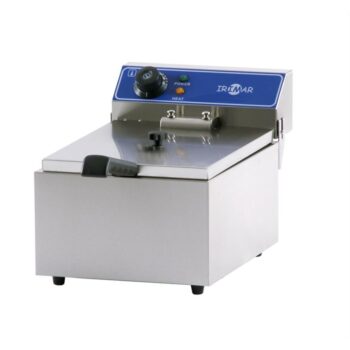
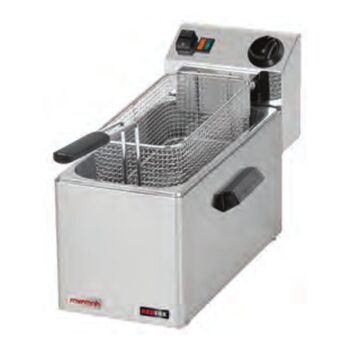
Irimar FRY-4 countertop electric fryer with 3.5 L of oil
122,00 € + VAT · 147,62 € inc. VAT Add to basket -
Arilex EVO5 5 L countertop electric fryer (4 L of oil)
140,00 € + VAT · 169,40 € inc. VAT Add to basket -
Irimar FRY-8 countertop electric fryer with 6 L of oil
152,00 € + VAT · 183,92 € inc. VAT Add to basket -
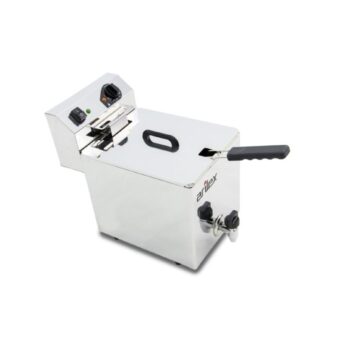
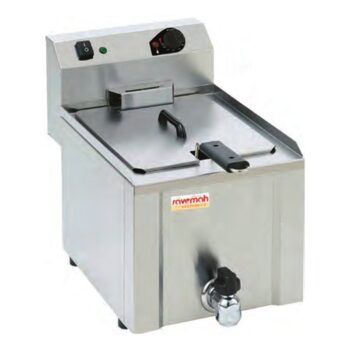
Irimar FRY-9 countertop electric fryer with 6 L of oil and tap
175,00 € + VAT · 211,75 € inc. VAT Add to basket -
Arilex EVO10 10 L countertop electric fryer (8 L of oil)
199,00 € + VAT · 240,79 € inc. VAT Add to basket -
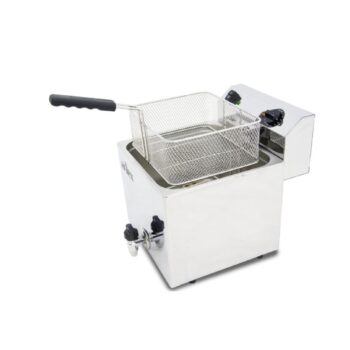
Irimar FRY-13 countertop electric fryer with 8.5 L of oil and tap
207,00 € + VAT · 250,47 € inc. VAT Add to basket -
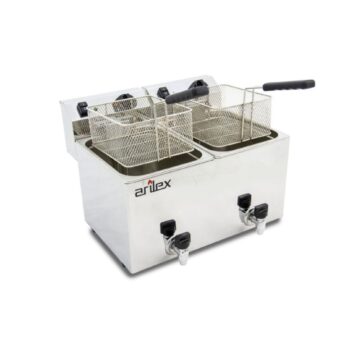
Irimar FRY-4+4 countertop electric fryer with 3.5 + 3.5 L of oil
223,00 € + VAT · 269,83 € inc. VAT Add to basket -
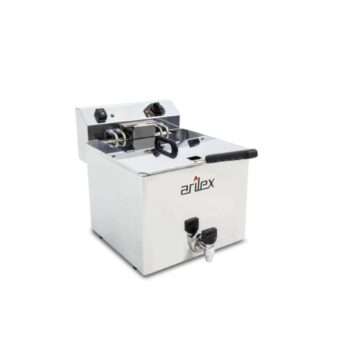
Arilex EVO10G 10 L countertop electric fryer (8 L of oil) with tap
252,00 € + VAT · 304,92 € inc. VAT Add to basket -
Arilex EVO55 5 + 5 L countertop electric fryer (4 + 4 L of oil)
257,00 € + VAT · 310,97 € inc. VAT Add to basket -
Arilex EVO12 12 L countertop electric fryer (10 L of oil)
262,00 € + VAT · 317,02 € inc. VAT Add to basket -
Irimar FRY-8+8 countertop electric fryer with 6 + 6 L of oil
279,00 € + VAT · 337,59 € inc. VAT Add to basket -
Arilex EVO12TR 12 L countertop electric fryer (10 L of oil), three-phase
311,00 € + VAT · 376,31 € inc. VAT Add to basket -
Irimar FRY-9+9 countertop electric fryer with 6 + 6 L of oil and tap
340,00 € + VAT · 411,40 € inc. VAT Add to basket -
Arilex EVO12G 12 L countertop electric fryer (10 L of oil) with tap
341,00 € + VAT · 412,61 € inc. VAT Add to basket -
Irimar FRY-18 electric pastry fryer with 12 L of oil and tap
360,00 € + VAT · 435,60 € inc. VAT Add to basket -
Irimar FRY-13+13 countertop electric fryer with 8.5 + 8.5 L of oil and tap
361,00 € + VAT · 436,81 € inc. VAT Add to basket -
Arilex EVO1010 10 + 10 L countertop electric fryer (8 + 8 L of oil)
365,00 € + VAT · 441,65 € inc. VAT Add to basket -
Arilex EVO12GTR 12 L countertop electric fryer (10 L of oil) with tap, three-phase
377,00 € + VAT · 456,17 € inc. VAT Add to basket -
Arilex 40FRE12G freestanding modular electric fryer, 12 L (10 L of oil), with tap
411,00 € + VAT · 497,31 € inc. VAT Add to basket -
RM Gastro FES-8LG PESC 8-litre countertop electric fish fryer with long basket
459,00 € + VAT · 555,39 € inc. VAT Add to basket -
Arilex EVO1010G 10 + 10 L countertop electric fryer (8 + 8 L of oil) with tap
462,00 € + VAT · 559,02 € inc. VAT Add to basket -
Arilex EVO1212 12 + 12 L countertop electric fryer (10 + 10 L of oil)
485,00 € + VAT · 586,85 € inc. VAT Add to basket -
Arilex EVO1212TR 12 + 12 L countertop electric fryer (10 + 10 L of oil), three-phase
505,00 € + VAT · 611,05 € inc. VAT Add to basket -
Savemah FRE-8 PLG 8-litre high-power countertop electric fryer with GN 1/2 tank
529,00 € + VAT · 640,09 € inc. VAT Add to basket
















Guides to choosing and using industrial electric fryers for catering
Practical advice related to this equipment.
How to improve frying if your electric fryer loses temperature
Are your chips coming out soft or oily? Why an electric fryer loses temperature and how to improve frying…
Read the tip
How to get perfect fried fish in a professional kitchen
Why the temperature of the electric fryer decides how fried fish turns out, which mistakes to avoid and how to choose the model according to daily portions.
Read the tipHow to choose a commercial electric fryer
A commercial electric fryer is chosen on five points: the litres of oil, the number of tanks, whether it has a drain tap or a removable tank, the format and the voltage the installation can take. All five appear in the technical data on each product page and are explained below.
Before buying, check
- The power supply. Single-phase or three-phase, and the contracted power of the premises before connecting the fryer to the same circuit as other cooking equipment.
- The space. Width, depth and clear height, with the basket raised.
- Extraction. Frying produces steam and airborne grease, also with an electric fryer, so plan where the unit will stand in relation to the extractor hood of the kitchen.
- The vacuum. Where you will collect and filter the used oil, and whether there is height underneath for the container if the model has a tap.
Capacity in litres and power
The figure that counts is the litres of oil, not the tank size. The models in this section are grouped by litres of oil, number of tanks and format; the space available and the workload decide between them, and each model's product page shows its power and whether it works at 230 V or 400 V.
- One tank with 3.5 to 4 litres of oil. countertop electric fryer with 3.5 L of oil and 5 L countertop electric fryer (4 L of oil).
- One tank with 6 to 8 litres of oil. countertop electric fryer with 6 L of oil, countertop electric fryer with 6 L of oil and tap and 10 L countertop electric fryer (8 L of oil).
- One tank with 8.5 to 10 litres of oil. countertop electric fryer with 8.5 L of oil and tap and 12 L countertop electric fryer (10 L of oil).
- Two countertop tanks, from 6 + 6 to 10 + 10 litres of oil. Each tank works separately. countertop electric fryer with 6 + 6 L of oil and tap, countertop electric fryer with 8.5 + 8.5 L of oil and tap and 12 + 12 L countertop electric fryer (10 + 10 L of oil) with tap.
- Freestanding modular models with two or three tanks. 12 + 12 L freestanding modular electric fryer (10 + 10 L of oil) with tap and freestanding modular electric fryer with 3 tanks of 12 L (10 L of oil per tank) with tap.
- Freestanding with cabinet, 26 litres of oil. freestanding electric fryer with cabinet, 26 L of oil and tap.
The litre figure does not mean the same in the two brands
It is the first thing worth checking, because the two brands in this section measure different things:
- On Arilex fryers, the figure is the nominal tank capacity. Their 10-litre model is a 10-litre tank that works with 8 litres of oil; the 12-litre one, a 12-litre tank with 10 litres of oil.
- On Irimar fryers, the figure is the oil volume itself. Their «8.5-litre» model takes 8.5 litres of oil.
That is why the 10 L countertop electric fryer (8 L of oil) and the countertop electric fryer with 8.5 L of oil and tap take practically the same oil —8 and 8.5 litres— even though one is sold as a 10-litre and the other as an 8.5. This is the equivalence by actual litres of oil in the single-tank models:
- 3.5 litres of oil: the smallest single-tank countertop model, and its double version.
- 4 litres: the countertop model with a 5-litre tank, and its double version.
- 6 litres: the two countertop models with 6 litres of oil, one with a removable tank and the other with a tap.
- 8 litres: the models with a 10-litre tank, with and without a tap.
- 8.5 litres: the countertop model with 8.5 litres of oil and tap, and its double version.
- 10 litres: all the models with a 12-litre tank, both countertop and freestanding modular.
- 12 litres: the pastry fryer.
- 26 litres: the freestanding model with cabinet.
In the two- and three-tank models the figure is split between them: the 12 + 12 litre tank double takes 10 + 10 litres of oil, and the 8.5 + 8.5 double already states litres of oil. Every product page shows both figures separately, and the one that tells you how much oil to buy is always the oil figure.
How much oil to buy for the first fill
The first fill is the oil volume shown on the product page, and it is worth having it ready on the day the unit arrives:
- 3.5 and 4 litres (the two smallest): one 5-litre container.
- 6 litres (the two with 6 litres of oil): two 5-litre containers.
- From 8 to 10 litres (the 10 and 12 litre tank models and the 8.5 litre oil model): two 5-litre containers.
- Two tanks of 8+8 or 10+10 (the countertop doubles): four 5-litre containers.
- Three tanks of 10 + 10 + 10 (the three-tank modular models): six 5-litre containers.
- 26 litres (the freestanding model with cabinet): six 5-litre containers.
The power of each model and the current it draws at 230 V or 400 V are detailed further down, in the section on single-phase and three-phase fryers.
Double and two-tank electric fryers
- One tank. Everything you fry shares the same oil. It is the option when you fry only one type of food or when the volume does not justify two tanks.
- Two tanks. Each tank has its own element and its own control, so you can keep two different temperatures and separate strong-flavoured foods, such as fish, from the rest. It also lets you keep frying while the oil in the other tank is filtered or changed.
- Three tanks. Only on the freestanding modular models, with 10 + 10 + 10 litres of oil.
Two tanks of 6 + 6 litres are not the same as a single 12-litre tank: the advantage is not in the total volume but in being able to work two oils at once.
Electric fryers with drain tap
The tap is at the bottom of the tank and lets you drain the oil into a container without lifting anything. In this section the freestanding modular models, the cabinet model, the pastry fryer and, in the countertop range, the versions that say so in their name have a drain tap. The title of each product page always states whether the model has a drain tap or a removable tank.
The twelve models with a removable tank are emptied by lifting off the head and tipping the tank itself, which is practical in small capacities. From 8 litres the tap saves time and avoids handling hot oil. The clearest pair is the countertop electric fryer with 6 L of oil, with removable tank, compared with the countertop electric fryer with 6 L of oil and tap, which has the same capacity with a tap.
If you choose a model with a tap, check that there is clear height under the unit for the container.
Countertop and freestanding fryers
- Countertop. It sits on a bench or work table. It is the format of most of the models in this section, and the one that takes up least space: the 5 L countertop electric fryer (4 L of oil) is 180 mm wide.
- Freestanding modular. Six models, 523 mm deep and 392 mm high, to fit in line with the other modules in the series and form a continuous cooking block. The smallest is the single-tank 12 L freestanding modular model.
- Freestanding with cabinet. The freestanding electric fryer with cabinet, 26 L of oil and tap, 1,100 mm high in total, with castors, adjustable feet and storage space underneath.
Single-phase and three-phase fryers: 230 V and 400 V
It does not depend on the number of tanks, but on the version you choose:
- 230 V single-phase. This includes all the Irimar two-tank models and the standard Arilex single- and two-tank versions. They connect without a three-phase installation; each product page states whether the model works at 230 V or 400 V.
- Three-phase. The remaining eight: the three-phase versions of the countertop range, the three three-phase freestanding modular models and the 26-litre freestanding cabinet model. Seven of the eight work at 400 V; the three-tank modular model is three-phase.
The three-phase version has more power per tank —7.5 kW against 4.5 kW—, which lets it recover temperature faster during service. You can see it clearly by comparing the 12 L countertop electric fryer (10 L of oil) with its three-phase version. If your premises do not have three-phase, the equivalent single-phase version always appears in the comparison on each product page.
This is the approximate current for each configuration, calculated on the power of each fryer, so you can check whether the circuit can take it:
- 3.2 kW at 230 V single-phase (the 5-litre tank model): about 14 A.
- 4 kW at 230 V single-phase (the 6-litre oil models with tap and the pastry fryer): about 17 A.
- 4.5 kW at 230 V single-phase (the single-phase 12-litre tank models, countertop and modular): about 20 A.
- 5 kW at 230 V single-phase (the 8.5-litre oil model): about 22 A.
- 7 kW at 230 V single-phase (the 10 + 10 litre tank double): about 30 A.
- 9 kW at 230 V single-phase (the single-phase 12 + 12 litre tank doubles): about 39 A.
- 10 kW at 230 V single-phase (the 8.5 + 8.5 litre oil double): about 43 A.
- 13.5 kW at 230 V single-phase (the single-phase three-tank modular model): about 59 A. By far the highest draw in the whole section.
- 7.5 kW at 400 V three-phase (the three-phase 12-litre tank models, countertop and modular): about 11 A per phase.
- 9 kW at 400 V three-phase (the 26-litre freestanding cabinet model): about 13 A per phase.
- 15 kW at 400 V three-phase (the three-phase 12 + 12 litre tank doubles): about 22 A per phase.
As soon as it is confirmed, it will be added.
Cold zone
The cold zone is the space under the element where frying debris falls, so that it does not burn or taint the oil. All twenty Arilex models have it, both countertop and freestanding modular.
Professional electric fryer for bars and restaurants
The choice depends on the space available, the workload, the capacity of each tank, the power and the electrical installation of the premises; each model's product page shows the litres, the power and whether it works at 230 V or 400 V. The type of food also counts:
- Frozen chips in volume. What matters is not the litres but how quickly the fryer recovers temperature when the food goes in. Here the three-phase version of the same model and the two-tank models, which spread the load, come out on top.
- Fish and seafood. A separate tank, so the flavour does not pass to everything else. A clear case for two tanks.
- Battered, breaded foods and croquettes. They leave a lot of debris at the bottom: a drain tap is worth having to filter the oil often without dismantling anything.
- Churros, sweet doughs and pastry. The pastry electric fryer with 12 L of oil and tap is the one designed for this: 12 litres of oil in a wide, low unit (480 × 450 × 240 mm compared with 310 × 480 × 350 mm for the 8.5-litre oil model), to fry flat pieces that float rather than food that sinks in a narrow tank.
Electric or gas fryer
The electric fryer needs a socket sized for its power and needs no gas installation or gas inspection, so it is the option when the premises have no gas supply or the fryer goes in an area without one. Also, our gas range starts at 12 litres: below that capacity we only have electric models.
The gas fryer adds no load to the electrical board, which is what you need to check when the same circuit already has an oven, griddle and dishwasher. If that is your situation, the section on gas fryers has tanks from 12 to 25 litres, in single- and two-tank models.
If you are unsure between an electric and a gas fryer for catering, in commercial fryers for catering you can compare both ranges.
If the electric fryer is for a takeaway business, also see the griddles, refrigerated preparation counters and EPOS systems with pagers for order collection that we have brought together for this type of business. Equipment for takeaways and food trucks →
Frequently asked questions about commercial electric fryers
How much oil do I need to fill the fryer?
Between 3.5 litres in the smallest and 26 in the freestanding cabinet model. Each product page shows the oil volume separately from the nominal tank capacity, and that is the figure to look at when buying oil.
What is the difference between tank capacity and litres of oil?
Tank capacity is the total volume of the tank; litres of oil are what actually goes in, between the maximum and minimum marks. Arilex states the first figure and Irimar the second, so a 12-litre Arilex takes 10 litres of oil and a 12-litre Irimar takes 12.
Can I plug a two-tank fryer into a single-phase installation?
Yes, as long as the model is the single-phase one. There are two-tank models both at 230 V and three-phase; the technical data on each product page states it. A single-phase 12 + 12 litre double draws about 39 A, so it is worth checking the electrical board.
What does a three-phase fryer gain over a single-phase one?
The three-phase version has more power per tank —7.5 kW against 4.5 kW—, which lets it recover temperature faster during service. It also spreads the load across the three phases instead of loading just one.
How many amps does a commercial electric fryer draw?
The quick rule at 230 V single-phase is to divide the watts by 230: a 4.5 kW fryer draws about 20 A and a 9 kW double about 39 A. At 400 V three-phase the load is spread across the three phases and 7.5 kW comes to about 11 A per phase.
What temperature does a commercial electric fryer work at?
Up to 190 °C working temperature, with an adjustable thermostat and a second manual-reset safety thermostat. That is the case on the models in this category.
What is the cold zone and which models have it?
It is the space under the element where frying debris falls, so that it does not burn or taint the oil. All twenty Arilex models have it, both countertop and freestanding modular.
What is the difference between the two fryers with 6 litres of oil?
Three things: one has a drain tap and the other a removable tank, the one with the tap delivers 4,000 W against 3,000 W for the other, and their external dimensions are different.
Are the baskets included?
Yes. All thirty product pages state how many baskets come with the unit and their dimensions, in the technical data.
Can a modular fryer be installed on a bench?
The freestanding modular models are designed to fit in line with the other modules in the series. If you are going to place it on a bench, check the 523 mm depth and 392 mm height.
Do I need an extractor hood for an electric fryer?
Frying produces steam and airborne grease, also with an electric fryer, so a suitable extraction system is usual in a professional kitchen.
Which fryer is best for churros or sweet doughs?
The pastry fryer, with 12 litres of oil, which is wide and low for frying flat pieces that float, instead of the narrow, deep tank of chip fryers.
Can the two tanks be used independently?
Yes. In the two- and three-tank models each one has its own element and thermostat, so they can be set to different temperatures or one can be switched off when service slows down.
What is the difference between an electric fryer and a gas one?
The installation and the capacity. The electric fryer needs a socket sized for its power, which in this section ranges from 2,000 W to 22.5 kW depending on the model, single-phase or three-phase, and needs no gas installation. The gas fryer needs a gas installation and its inspection. In our range, below 12 litres of oil we only have electric fryers.
How much does a commercial electric fryer cost?
It depends on the litres of oil, the number of tanks, the power, whether it has a drain tap, the format (countertop, freestanding modular or with cabinet) and the voltage, 230 V or 400 V. The small single-tank countertop models are the most affordable and the three-tank freestanding modular models the most expensive. The current price of each model is shown in the listing and on its product page.
Advice and purchase
If you are unsure what capacity you need, whether one tank or two suits you, or whether your installation can take a three-phase unit, ask us on 622 872 311 and we will advise you before you buy. Shipping in 3 to 5 days to mainland Spain.
