
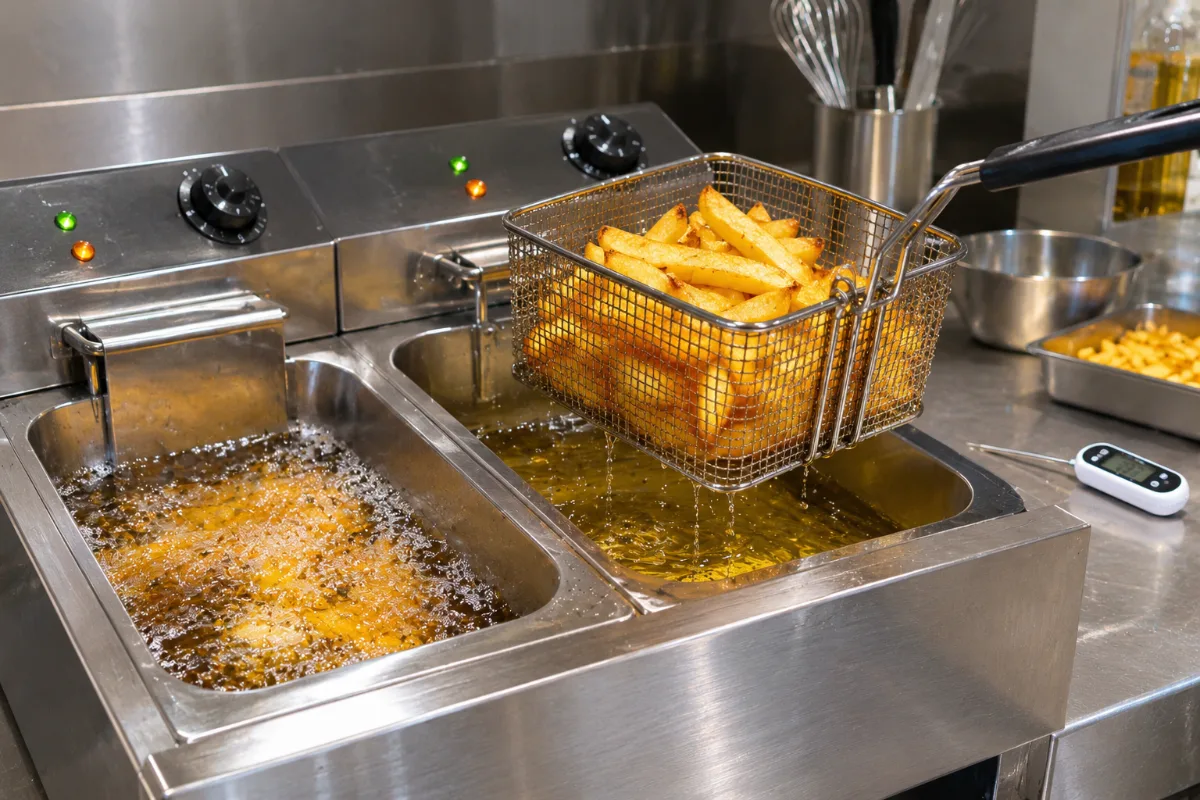
This article is aimed at any kitchen that works with a fryer: it explains why the same product comes out differently over the course of service and how to make the first and last portion come out the same. It is the frying reference for the rest of the recipes, which link to this article instead of repeating it.
Why results change during service
The oil temperature drops every time food goes into the tank. The water in the food evaporates, absorbs heat and the oil takes a while to recover. If the next basket goes in before it recovers, the food fries at a lower temperature, takes longer to form a crust and absorbs more fat.
The temperature drop is greater with large loads relative to the oil volume, with wet food and with frozen food covered in ice crystals. Oil also degrades with use: it darkens, foams more and transfers heat less well, so the same thermostat setting no longer gives the same colour.
Working temperature
The usual frying temperature is between 170 and 175 °C for most products, with a lower first fry of around 150-160 °C when working in two stages, as with potatoes.
For chips and other cut potato products, Regulation (EU) 2017/2158 requires food businesses to apply measures to reduce acrylamide, including frying below 175 °C and removing the potatoes when golden, with no dark spots. This obligation applies to those potato products, not to all frying; for everything else, a moderate temperature also slows down oil degradation.
Practical tips
- Fill the fryer basket no more than halfway and always keep the same quantity per batch: frying time will be repeatable.
- Wait for the thermostat light to show the oil has recovered its temperature before putting in the next basket.
- Dry fresh food and shake the ice off frozen food over the tray, never over the tank.
- Salt the food away from the fryer: salt that falls into the oil speeds up its degradation.
- Separate tanks by product family: fish and battered food on one side, potatoes on the other. Flavours are not transferred and it helps control the presence of allergens.
- Remove crumbs during service with a skimmer and filter the oil at the end.
- Top up the oil used frequently to keep the level. If a lot needs topping up, change all the oil.
- Check the oil condition with a polar compounds tester and change it before it reaches 25 %, the usual reference value.
Electric or gas fryer
An electric fryer with immersed elements transfers heat directly to the oil, offers a precise thermostat and recovers temperature quickly with medium loads. It is installed with a suitable power socket and is practical for bars and kitchens without a gas supply.
A gas fryer delivers a lot of power, suited to high volumes and services with continuous loads, such as fried-fish shops or high-output kitchens. It requires a gas installation and the corresponding extraction.
The double-tank fryer, with either energy source, lets you separate products and work with one tank at first-frying temperature and another at finishing temperature. The cold zone under the elements or tubes collects the residue that falls without it burning, which extends the life of the oil.
These guidelines apply equally to gas fryers.
More dishes in our Cooking for professionals.


