
This article is for any kitchen that prepares food in advance: stews, béchamel, stocks or sauces. It explains the temperatures and time limits set by current Spanish regulations for cooling, storing and reheating prepared meals, and it is the food-safety reference for the recipes made before service.
Why cooling is the critical point
Regulations require prepared meals that will be refrigerated or frozen to reach their storage temperature as quickly as possible and, if cooked hot, for the core of the product to drop from 60 °C to 10 °C in under two hours (article 30 of Spanish Royal Decree 1086/2020, as amended by Royal Decree 1021/2022). A cold room is designed to maintain temperature, not to remove heat: a hot pot inside the cold room takes hours to cool at the centre and also raises the temperature of everything else.
Rapid cooling without a blast chiller
- Divide the food into shallow containers with a low depth of product: the thinner the layer, the faster the centre cools.
- Place the containers in an ice-water bath and stir liquids and sauces to renew the layer in contact with the cold.
- Leave the containers uncovered or with the lid ajar while they give off steam, protected from contamination.
- Move the product to the cold room as soon as the worst of the heat has gone, without leaving it at room temperature.
Chilling and blast freezing
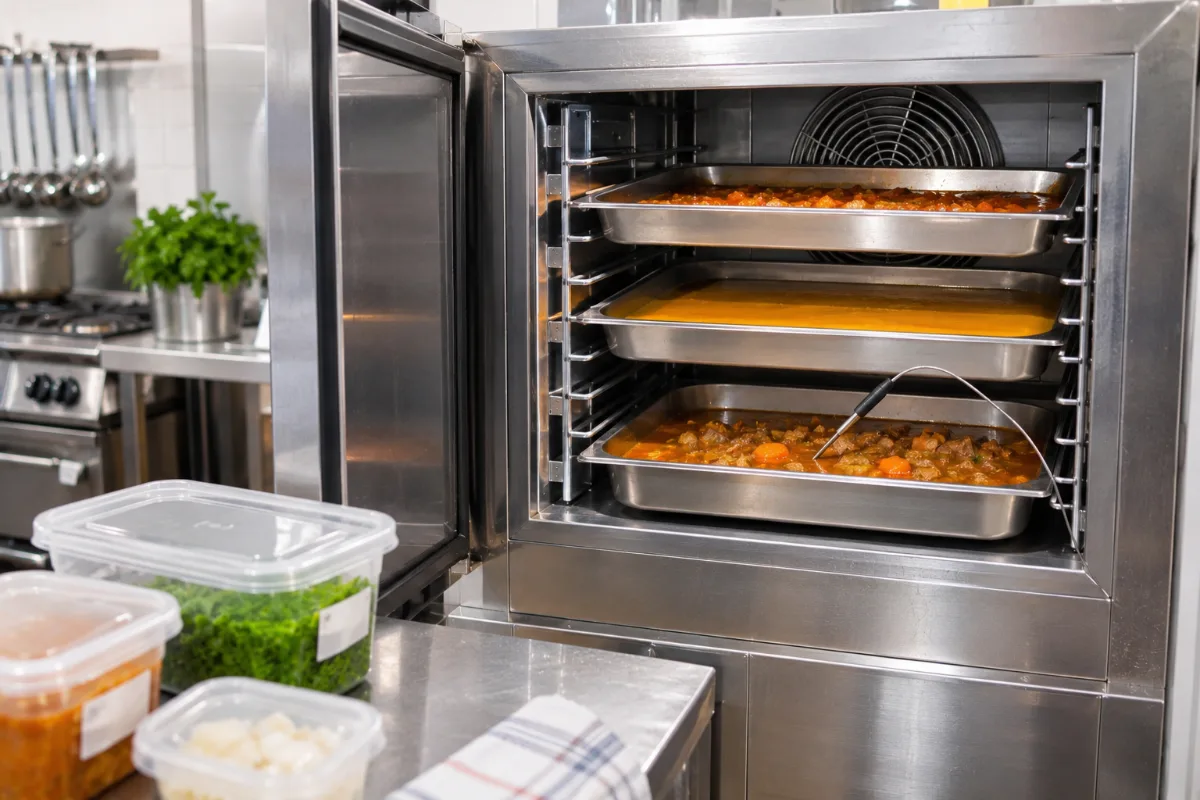
The blast chiller circulates very cold air at high speed over the product. As a usual reference for these units, not as a legal requirement, the positive cycle brings the food from 70 °C to 3 °C at the core in about 90 minutes and the negative cycle, or blast freezing, takes it down to −18 °C in about 4 hours.
Chilling with a core probe ensures the cycle ends when the centre of the product reaches the set temperature, not when a set time has passed. Blast freezing forms small ice crystals, so sauces, doughs and meats keep their texture better when thawed than with slow freezing in a chest freezer.
The difference between the two is one of safety and organisation: cooling in an ice bath works for small volumes, while a blast chiller cools whole batches in a known time that can be recorded.
Storage temperatures
General conditions for prepared meals (article 30 of Spanish Royal Decree 1086/2020):
- Refrigerated prepared meals with a shelf life of more than twenty-four hours: 4 °C or below inside the product.
- Refrigerated prepared meals with a shelf life of less than twenty-four hours: 8 °C or below.
- Frozen prepared meals: −18 °C or below.
- Meals kept hot until service: 63 °C or above.
Some preparations have specific requirements: those made with raw egg or egg products that are not stable at room temperature are kept at 8 °C or below and eaten within 24 hours at most, recording the date and time (Royal Decree 1021/2022, article 9), and fish served raw or marinated requires prior freezing (article 8), as explained in anchovies in vinegar.
Labelling and rotation
Each preparation's label should show, without opening the container, what it contains and until when it can be used. It should include:
- Name of the preparation.
- Preparation date and, if frozen, freezing date.
- Use-by date set by the establishment itself.
- Allergens present.
- Person responsible or batch, if the self-monitoring system requires it.
Stock rotation follows first in, first out: the oldest at the front and in view. Frozen meals are kept at −18 °C or below and thawed in the fridge, except in justified cases (Spanish Royal Decree 1021/2022, article 5).
Storage times
The shelf life of each preparation is set by the business in its self-inspection plan, according to the product, the packaging and the storage temperature. Vacuum packing extends the life of refrigerated product and protects it from odours and oxidation, but it does not replace cold. Reheating must reach at least 74 °C for fifteen seconds at the core of the food within one hour of it leaving the fridge (article 30 of Royal Decree 1086/2020). As good practice, anything reheated and not eaten is not reheated or stored again.
To keep the preparations to hand during service, refrigerated counters keep the day's product cold next to the workstation.
More dishes in our Cooking for professionals.


