
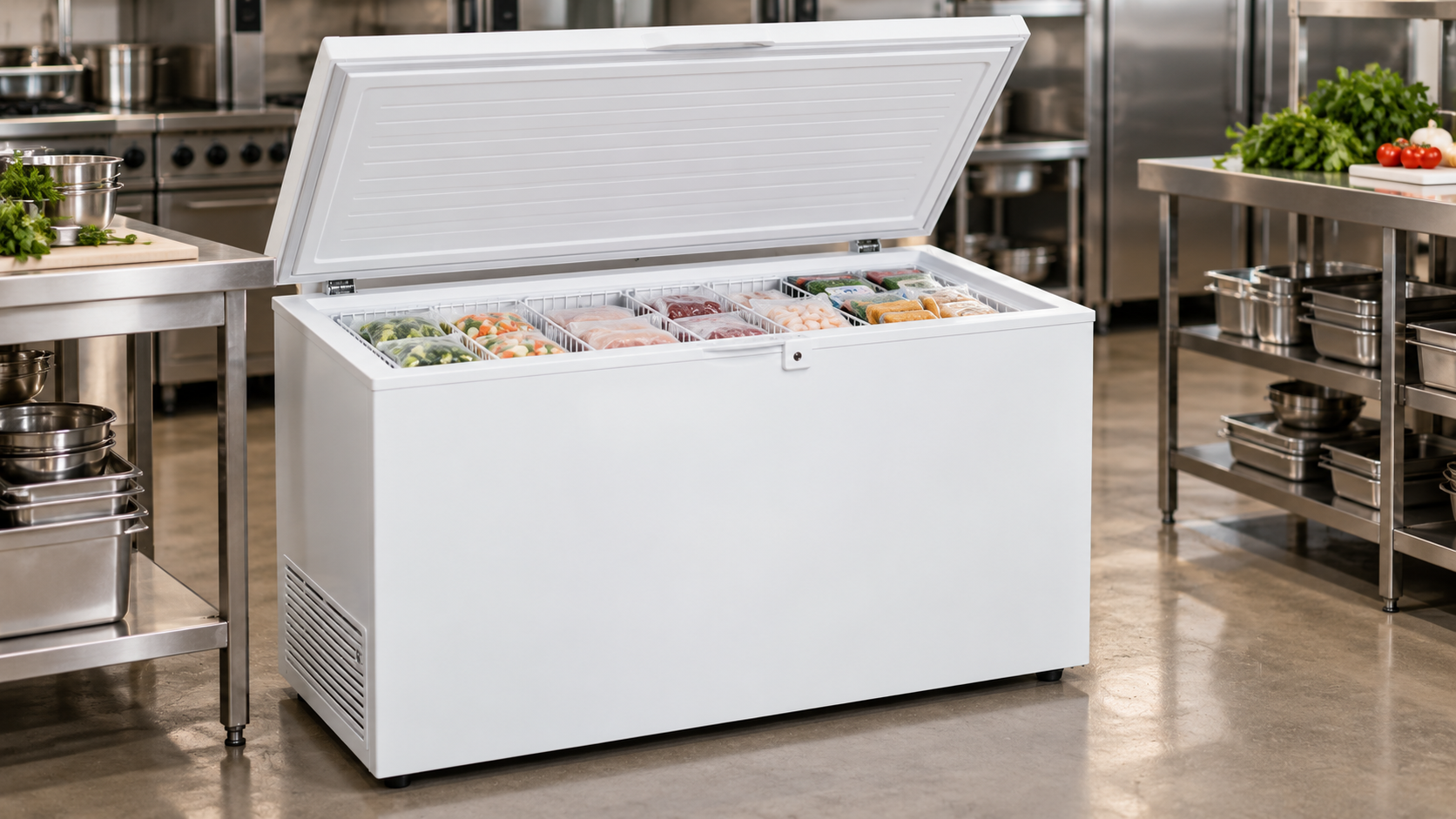
¿Necesitas guardar reservas en la cocina o mostrar congelados al cliente? Antes de elegir un arcón, conviene pensar en su uso diario: qué vas a almacenar, cuánto espacio tienes y cuántas veces tendrás que abrirlo.
Solid lid or glass lid?
The solid lid is a practical option for storage in kitchens, storerooms and workshops, where you do not need to see the product from outside. For small spaces, you can consider our 208-litre chest freezer with hinged lid , 83 cm wide.
The glass lid makes sense when the product must be on view, for example in a shop or self-service area. It lets customers choose before opening, as long as the inside is tidy. If you need to show the product to the customer, you can see this 261-litre curved glass chest freezer.
Opening also matters: a hinged lid needs free space above; a sliding one moves sideways. Check the manufacturer's installation and ventilation measurements before placing it under a shelf.
At what temperature should it work?
To store frozen food, the general reference is −18 °C or below, respecting the product instructions and the business's food safety checks. The temperature must be maintained in the food: the thermostat number alone does not guarantee that the whole load is equally cold.
Always setting it to maximum cold is not necessarily better. Adjust the unit to maintain the required preservation and check the temperature with a suitable thermometer. Do not confuse storing products that are already frozen with freezing fresh food: for the latter you must check the unit's freezing capacity, usually expressed in kg/24 h.
How to keep the cold better and reduce consumption
Hay pequeños hábitos que ayudan a que el equipo trabaje en mejores condiciones:
- Keep it away from ovens, griddles and direct sun. Respect the ventilation clearances indicated in its manual.
- Open it only for as long as necessary. Organise the products by family and use baskets to find what you are looking for.
- Check the seals and the closure. A badly placed bag or box can stop the lid from closing properly.
- Remove the frost following the manual. If the unit requires manual defrosting, do not let the ice build up or prise it off with sharp tools.
- Keep the accessible grilles clean, following the manufacturer's instructions.
Location, ventilation, closure and frost build-up all affect consumption. Lowering the temperature more than necessary also takes more energy.
Other questions worth answering
How many litres do I need? Think about the boxes and containers you use, how often you restock and the space to organise them. Do not go only by the advertised capacity.
Will it work in a very hot kitchen? Check the climate class and the maximum ambient temperature allowed. Not all units are prepared for the same conditions.
How do I compare what they use? Look for the declared consumption in kWh and its test conditions. Power in watts is not the same as daily consumption, because the compressor does not necessarily run continuously.
What do I do if it loses temperature? Check the closure, load, frost and ventilation. If it does not hold the necessary temperature, protect the goods and request a technical check; lowering the thermostat does not fix a fault.
Choose according to the way you work
See our selection of chest freezers to compare capacities, sizes and lid types.
Tell us what you need to store and how much space you have. We help you compare options before buying.
Maquinaria Hostelería MR
Website: maquinariahosteleriamr.com
WhatsApp: +34 622 872 311


