
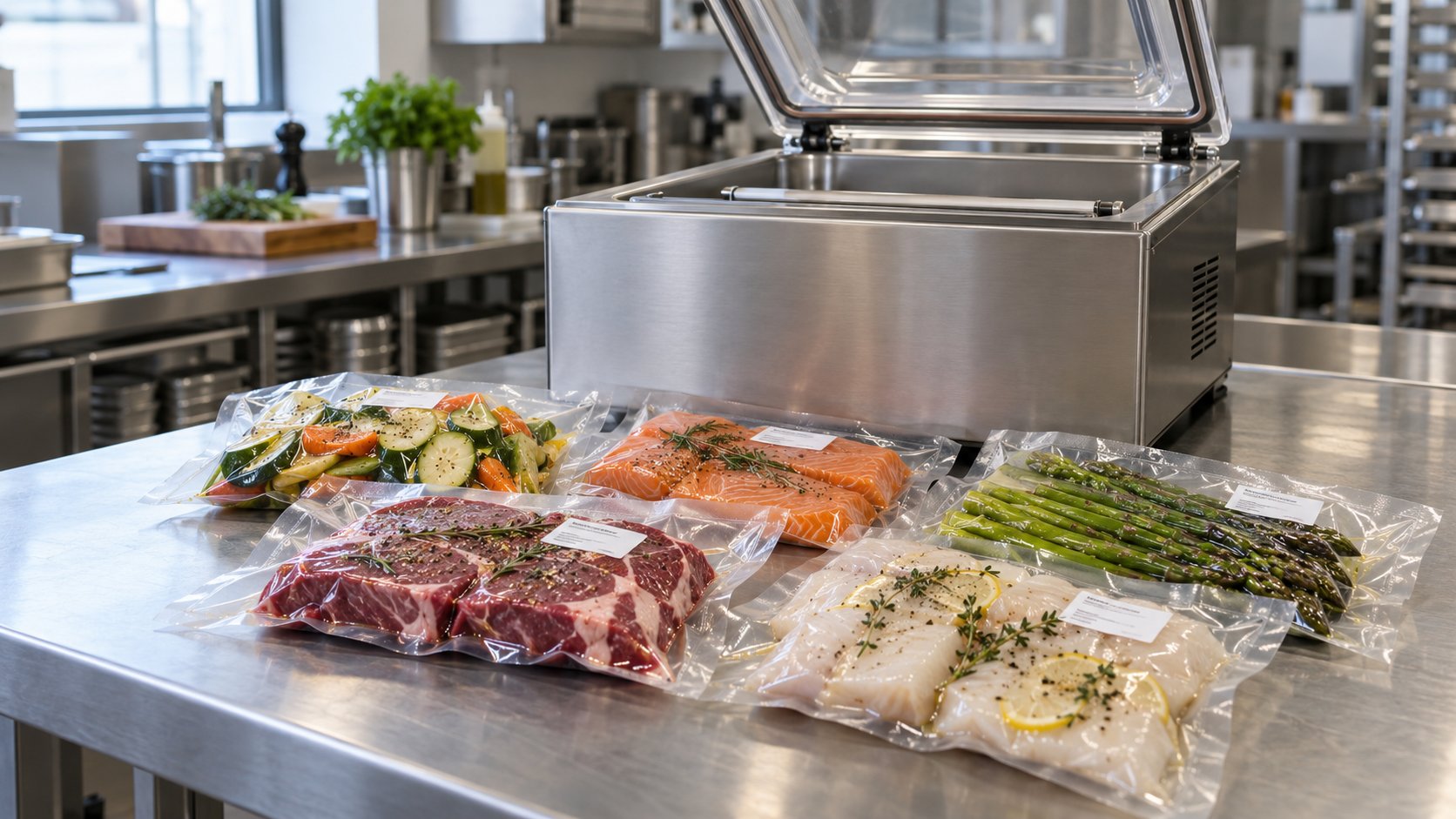
A vacuum packing machine extends the life of food, keeps the cold room organised and lets you prepare portions in advance. But many kitchens make the same mistakes again and again, and the result is bags that lose their vacuum, seals that open and product that spoils before its time. These are the seven most common mistakes when vacuum packing in hospitality and how to avoid them.
1. Packing food while it is still hot
A stew, a sauce or freshly cooked meat gives off steam. If the food goes into the packing machine hot, that steam makes the vacuum harder, dampens the sealing area and also breaks the cold chain. The right way is to cool the product first, ideally in a blast chiller, and pack it afterwards, already cold, to store it straight away in the cold room.
2. Overfilling the bags
An overfilled bag does not leave enough room to seal properly: the product sits against the mouth of the bag, the seal gets dirty and the closure fails. The bag should have a free margin between the food and the sealing area, and the size of the bag has to match the width of the machine's bar. For individual portions and small pieces, a chamber vacuum packing machine with a 260 mm sealing bar is a compact option for working with portion bags without wasting material.
3. Using a bag that does not match the machine
Not all bags are valid for all packing machines. Chamber machines work with smooth bags, while external suction machines need embossed bags, with a textured surface, to be able to extract the air. Using the wrong bag or a bag not suitable for food use results in incomplete vacuums and product that lasts less than expected.
4. Faulty seals
The seal is the point where most bags fail. Traces of fat, blood or liquid on the mouth of the bag prevent the plastic from sealing properly, and a badly adjusted sealing time leaves weak or burnt closures. It is advisable to clean the mouth of the bag before closing it, check the sealing bar frequently and adjust the time to the thickness of the bag. The chamber vacuum packing machine with a 400 mm bar lets you programme the sealing time and temperature and takes bags up to 400 mm wide, which makes it easier to get even closures on bags of different sizes.
5. Not labelling the bags
A vacuum bag without a label forces you to guess what it contains and when it was packed. In a professional kitchen each bag should carry, as a minimum, the name of the product, the preparation date and the use-by date. That way stock rotation is applied properly and the traceability required by health regulations is met.
6. Thinking that vacuum replaces cold
Vacuum packing extends preservation, but it does not turn a perishable food into a product that keeps outside the fridge. Vacuum bags of meat, fish, vegetables or cooked dishes must always go into refrigeration or freezing, like any other fresh food.
7. A machine too small for the production
When the workload grows, a small packing machine becomes a bottleneck: bags are packed one at a time, the kitchen waits and packing ends up being done in a rush, which is when the previous mistakes appear. For restaurants, workshops or central kitchens with high production, a vacuum packing machine on a cabinet with two 500 mm sealing bars and a square 520 × 520 mm chamber lets you pack several bags in each cycle and work with large pieces. If you still have doubts about which size your business needs, in the article which vacuum packing machine is the most recommended for your business we explain how to choose it.
Packing well is a matter of method and the right machine
Cooling before packing, leaving a margin in the bag, using the right bag, taking care of the seal, labelling and always keeping the cold chain are simple habits that avoid most problems. The rest depends on having a packing machine that matches the workload of each kitchen. You can see all the models available in our section of professional vacuum packing machines.


